AQI Safe for Kids in India: When to Keep Children Indoors (Simple Chart for Parents)
It is 6.45 in the morning. Your phone says the AQI is 377. Your daughter is already in her school shoes, and PT is the third period on her timetable. Do you send her to the ground or not?
Parents in Delhi are asking this exact question this week. So are parents in Mumbai, Kolkata, Kanpur, Patna, and a growing list of Indian cities where winter air is no longer only Delhi’s problem. Is there an AQI safe for kids? Time to find out.
What Is an AQI Safe for Kids?
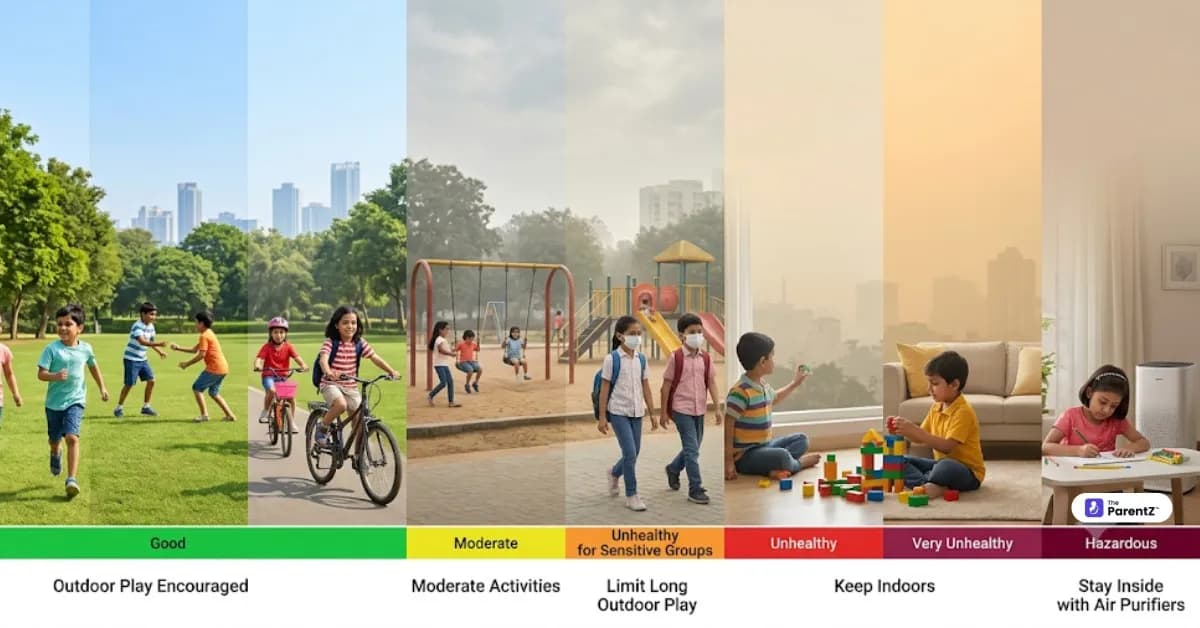
Up to 100, a healthy child can play as usual. Between 101 and 200, shorten hard sports. Above 200, outdoor time should shrink fast.
CPCB sorts air into six bands, and its official health notes say Poor air troubles the breathing of most people on prolonged exposure, while Severe air affects even healthy people. Children feel it sooner. WHO says kids breathe faster than adults and live closer to the ground, where some pollutants sit thickest. A number that feels manageable to you can be a real strain on a seven year old's lungs. Do teenagers need the same care? Older kids cope better, but a school athlete breathing hard at practice takes in more air, so the same limits apply to sports.
Delhi AQI Today and Why Parents Are Worried
Delhi's 24-hour average AQI stood at 377 on Wednesday 4 November, in the Very Poor band, as recorded in the Central Pollution Control Board's daily bulletin. That same day, independent monitoring by IQAir showed PM2.5 in parts of the city exceeding 461 micrograms per cubic metre, more than 30 times the WHO 24-hour guideline of 15 micrograms per cubic metre. October had still been the cleanest in eight years, with an average AQI of 166.
The jump was quick. AQI went from 117 on 31 October to 324 on 2 November, and CAQM invoked GRAP Stage II the same day. By 5 November, several stations had crossed 400, and the early warning system forecast Severe air from 6 November onward, right around Diwali.
What does this mean if you are not in Delhi? The same chart applies. Mumbai's AQI was 143 on 3 November, in the Moderate band, which means healthy children can still play but hard sports should be shortened. Kolkata was at 173. Both cities sat in the Moderate category, which CPCB says can cause breathing discomfort for children and for people with lung or heart disease. None of these cities has Delhi's GRAP machinery, so the decision rests with you and your child's school, not with a government circular. That makes the chart more important, not less.
If you are in Delhi-NCR, schools are following GRAP. Private schools are postponing outdoor activities and adding purifiers. The Directorate of Education told every school to hold special assemblies on 5 and 6 November about firecracker smoke, after the Supreme Court's 29 October order. Classes continue under Stage II. Under Stage III (AQI 401 to 450), schools move to hybrid mode for children up to Class 5. Under Stage IV (AQI above 450), hybrid mode extends to Classes 6 to 9 and Class 11, and organisers of physical sports tournaments in November and December are advised to reschedule.
If you are outside Delhi-NCR, there is no GRAP order to wait for. Your school decides. Ask the class teacher or the principal's office what the school's AQI threshold is for moving PT indoors, and ask whether the answer is in writing. Many schools outside the capital do not have a written policy. If yours does not, the chart above is your default.
AQI Chart for Parents: When to Keep Children Indoors
Check your area’s live AQI and find the matching row below. The bands and health notes come from CPCB. CPCB has no separate child chart, so the last column is a practical rule built on those notes and on GRAP advice for children.
AQI | Band | What CPCB says | What to do with your child |
|---|---|---|---|
0 to 50 | Good | Minimal impact | Play freely |
51 to 100 | Satisfactory | Minor discomfort for sensitive people | Normal play and PT |
101 to 200 | Moderate | Discomfort for people with lung or heart disease | Healthy kids can play, keep sports lighter, sensitive kids stay easy |
201 to 300 | Poor | Discomfort for most people on long exposure | Short time outside, no long sports, no early morning or late evening play |
301 to 400 | Very Poor | Respiratory illness on long exposure | Keep children indoors, go out only when needed |
401 and above | Severe | Affects healthy people, serious for the sick | Indoors all day, no outdoor activity |
Take this morning as a walkthrough. The AQI is 377, so the row says Very Poor. PT moves indoors, the bus ride is fine with a snug mask, and evening cricket waits for another day.
One rule overrides the chart. If your child coughs, rubs the eyes or breathes hard outside, go in, no matter what the number says.
Kids With Asthma and Small Children Need an Earlier Cutoff
Move the chart down one band for a child with asthma, a baby, or a toddler. Treat Poor like Very Poor and stay in. CPCB itself lists people with lung disease as the first to feel Moderate air.
Keep the reliever inhaler in the school bag. Talk to your paediatrician about a written action plan before the worst weeks. Ask the school to excuse your child from PT on bad days, and get that in writing too. Know the warning signs. Fast breathing, wheeze, a cough that will not settle, or a chest that pulls in with each breath all mean a call to the doctor right away.
Children recovering from even a mild viral infection also need the earlier cutoff. Their airways stay reactive for several days after the infection settles. Apply the same one-band-earlier rule for at least a week after any cough or fever.
How to Check the AQI Before School
Check the live number between 6.30 and 7 am in CPCB's SAMEER app, which carries station-level data across India, or on your state pollution control board's site. In Delhi, the Delhi government AQI site is the fastest option. Read the station nearest your home and school, not the city average. City averages hide hotspots. Save your area as a favourite in the app so the check takes ten seconds.
Then open the Directorate of Education circulars page for any fresh order, since schools follow it. CAQM’s orders page shows which GRAP stage is active. Does one bad morning mean a bad day? Not always, as winds and sunshine can clear the air by afternoon, so check again at noon.
Outside Delhi-NCR, there is no CAQM orders page to check. The SAMEER station reading and your school's own policy are your two reference points.
Mask for Children, Does It Help?
A cloth mask or scarf filters fine particles poorly. A snug N95 or KN95 without a valve works better for the school run, since fit matters more than brand. Paediatric guidance is clear that masks should not be used on children under two years old. For children over two, a well fitted child sized N95, KN95 or FFP2 offers better protection than cloth when outdoor exposure cannot be avoided.
A mask cuts exposure on the road. It does not make a severe day safe for games.
Air Purifier for Kids and Cleaner Air at Home
A purifier helps most in the room where your child sleeps and studies, with doors and windows shut. Pick one rated for that room’s size and run it through the night. Check the filter date, because a clogged filter does little.
Small habits add up. Skip incense and mosquito coils on bad days. Mop floors instead of sweeping, since a broom lifts dust. Keep windows closed when the AQI is above 300.
When Can Kids Return to Outdoor Play?
Send them out again once the AQI drops under 200 and stays there for the day. Choose afternoon over early morning or late evening, because many advise skipping exertion at those hours on poor to severe days.
Restart slowly. Begin with 30 minutes of light play and watch for cough, wheeze or tired eyes. Bring the child back in at the first sign.
What do children do indoors meanwhile? Try skipping rope, dance, yoga, chess, carrom, or a drawing hour. Indoor days can still be active days.
How to Handle Diwali Week With Children
Keep children indoors during the cracker windows and for a few hours after, since smoke builds up fast. In Delhi-NCR, the Supreme Court allowed certified green crackers only on 7 and 8 November, in two windows, 6 to 7 am and 8 to 10 pm. Outside the capital region, state rules vary. Some states allow green crackers with local time limits; others have tighter restrictions. Check your state pollution control board's order for the exact window in your city.
Green crackers are designed for at least a 30 percent reduction in particulate emissions compared with conventional crackers, not a 100 percent reduction. That is meaningfully less smoke, but it is still smoke. Light diyas and rangoli with your kids, watch the sky from a closed window, and save the sparklers for a day when the AQI is lower. Plan an indoor evening with sweets and games.
Is it rude to say no to the neighbourhood cracker session? Not at all. A short, friendly line works. Say your child has a cough season and stays in.
Key Takeaways
An AQI safe for kids stays under 100 for free play and under 200 for limited play.
Keep children indoors above 300.
Step the chart down one band for asthma, babies and toddlers.
Check the live AQI at your nearest station before school.
Treat a mask as a school run aid, never as a ticket to play.
Return to outdoor time only after the AQI stays under 200.
GRAP applies to Delhi-NCR only. Outside it, your school's written policy and the CPCB station nearest you are your decision tools.
FAQs
At what AQI should kids stay indoors?
Keep children indoors above 300, and cut outdoor time sharply from 201. Children with breathing trouble should stay indoors from 201.
Is AQI 200 safe for kids?
AQI 200 is the top of the Moderate band. Healthy children can play briefly with lighter sports, but a child who wheezes should stay indoors.
Is AQI 150 safe for children to play outside?
Mostly yes for healthy children, with short sessions and no heavy sports. Watch for cough or itchy eyes.
Should schools close when the AQI is above 300?
Not automatically. Schools stayed open under GRAP Stage II this week, and hybrid classes come only at higher stages, so follow the Directorate of Education circular.
Does a mask protect children from pollution?
A snug N95 type reduces exposure outdoors, but cloth masks filter fine particles poorly. Ask your paediatrician first.
Can children exercise indoors when the AQI is high?
Yes. Light indoor activity keeps energy levels up and does no harm. Keep windows shut and avoid dusty rooms.
Can babies go outside when the AQI is above 200?
Keep babies indoors above 200. Take them out only on Good or Satisfactory days, and only for short spells.
More in this Category
What to Do When Your Baby Is Refusing Food - A Complete Guide

10 Things You’ll Wish You Had Written Down Before Your Baby’s Next Doctor Visit
Preparing for your baby's doctor visit? Discover 10 important things to write down beforehand, including health changes, feeding habits, sleep patterns, diaper changes, medications, developmental milestones, and questions to ask the pediatrician.

11 Baby Details Parents Should Record Before They Forget Them
Babies grow and change quickly, and many precious moments can easily be forgotten. Discover 11 important baby details parents should record, including birth information, first smiles, first words, feeding habits, sleep patterns, growth measurements, and developmental milestones.

Children’s Day 2026: 10 Meaningful Ways to Make Every Child Feel Seen Beyond Fancy Dress
Child Cough After Diwali: Smoke Irritation or Infection?

Baby Milestone Tracker App for New Parents: How to Track Milestones Effortlessly
Discover how a baby milestone tracker app can help new parents record important developmental milestones, track new skills, and keep a clear history of their baby's progress over time.