Homemade vs Store-Bought Baby Food: A Complete Guide for Indian Parents
Key Takeaways
Homemade baby food offers freshness and control, while store-bought baby food provides convenience and safety; most experts recommend a balanced mix of both for optimal infant nutrition.
Homemade baby food offers freshness and control, while store-bought baby food provides convenience and safety; most experts recommend a balanced mix of both for optimal infant nutrition.
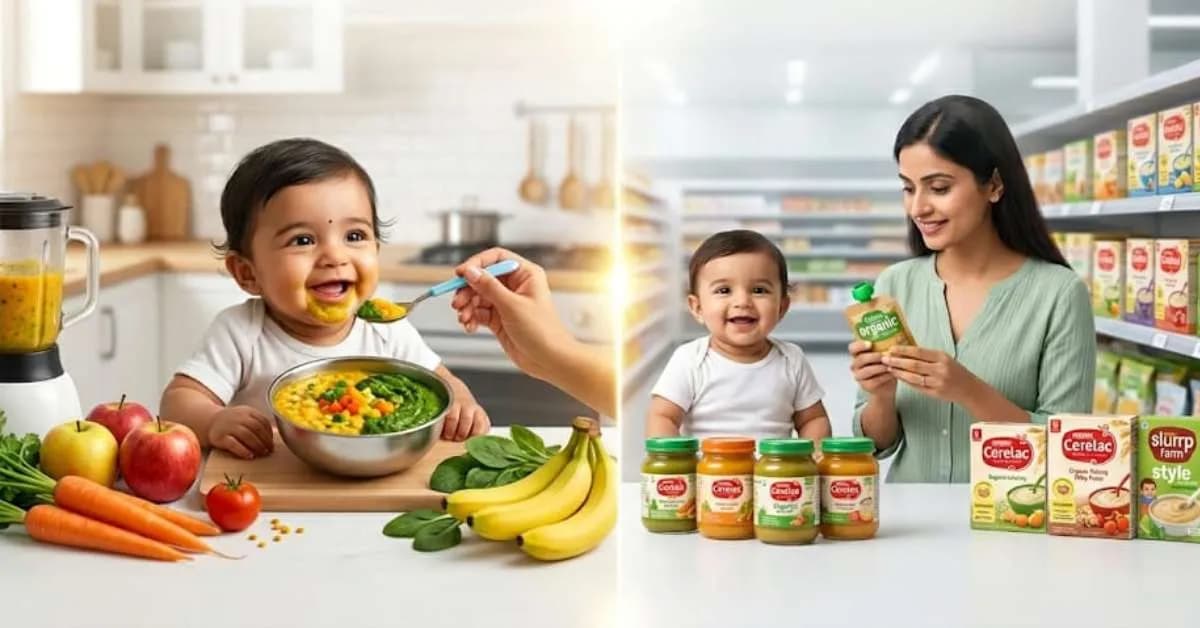
The moment your baby turns six months old, a familiar question surfaces in every household - should I make baby food at home, or is packaged baby food good enough?
It is one of the most debated topics among new parents today, and for good reason. The food your baby eats in the first two years of life shapes their gut health, immunity, taste preferences, and long-term growth. Getting it right matters - but so does being realistic about time, budget, and convenience.
This article is based on current guidelines from pediatric bodies such as WHO, IAP, and global infant nutrition research, adapted specifically for Indian dietary patterns and feeding practices.
This guide breaks down the homemade vs store-bought baby food debate with clarity, science, and a practical lens for Indian families. There is no single right answer - but there is the right answer for you.
The Quick Verdict: Homemade baby food offers better freshness, cost savings, and texture variety, while store-bought baby food offers FSSAI-regulated safety and convenience. Most pediatricians recommend a hybrid approach: fresh homemade meals (like Ragi and Khichdi) for daily nutrition and fortified packaged foods for travel or iron-gap supplementation.
Key Takeaways
WHO and IAP recommend starting solid foods at 6 months, alongside continued breastfeeding
Homemade baby food benefits include freshness, full ingredient control, and significantly lower cost, especially with Indian staples like ragi, khichdi, and dal
Packaged baby food is regulated by FSSAI in India, undergoes pathogen and contaminant testing, and is a safe, convenient option when used thoughtfully
Current research shows that nutritional quality can vary widely between homemade and commercial baby foods. While homemade meals often provide better texture diversity and fewer additives, many commercial options are fortified with essential nutrients like iron and vitamin D, which can be beneficial for infants at risk of deficiencies.
A hybrid approach: homemade daily, packaged as backup - works best for most Indian families
Always read labels carefully on store-bought baby food products; check for added sugars, sodium, and actual ingredient percentages
When in doubt, consult a pediatric nutritionist or your child’s doctor
When Should Babies Start Solid Foods?
Before choosing between homemade and packaged options, timing matters. The World Health Organization (WHO) and the Indian Academy of Pediatrics (IAP) both recommend exclusive breastfeeding for the first six months. After that, complementary foods should be introduced gradually alongside breastmilk.
Signs your baby may be ready for best baby food for 6 months introduction include:
Holding their head steady without support
Showing interest in foods others are eating
Loss of the tongue-thrust reflex (not pushing food out automatically)
Sitting upright with minimal support
Always consult your pediatrician before starting solids in India, as readiness varies from baby to baby.
Homemade Baby Food: What the Research Says
The Benefits of Making Baby Food at Home
Homemade baby food benefits are well-documented. When you prepare food fresh at home, you control every ingredient - the quality of vegetables, the absence of added salt, sugar, or preservatives, and the texture that suits your baby’s current developmental stage.
Research published in Nutrition Research Reviews suggests that homemade baby foods may offer greater ingredient variety and texture diversity, while many commercial baby foods are fortified with nutrients such as iron and vitamin D. For Indian parents, especially, this is significant because the best baby food for Indian babies is often already sitting in your kitchen.
Traditional Indian weaning foods like:
Ragi (finger millet) porridge - rich in calcium and iron, excellent for bone development
Moong dal khichdi - a complete protein source that is gentle on the digestive system
Dal water and lentil soups - high in iron and easy to digest
Rava (semolina) porridge - light, energy-giving, and easy to prepare
Mashed banana or papaya - natural source of potassium and digestive enzymes
These are time-tested, nutritionally dense options that generations of Indian families have relied on. When prepared hygienically, baby food puree at home from these ingredients gives your baby fresh nutrition without any additives. Explore Baby First Foods Database
Limitations of Homemade Baby Food
Homemade food comes with genuine challenges:
Requires planning, prep time, and safe storage
Nutritional content can vary depending on cooking method (boiling reduces water-soluble vitamins like B and C)
Risk of contamination if hygiene is not strictly maintained
No fixed shelf life - must be consumed within 24-48 hours or frozen properly
Store-Bought Baby Food: What Indian Parents Should Know
The Case for Packaged Baby Food
Packaged baby food has earned its place in modern parenting for valid reasons. Reputable brands formulate their products with the guidance of nutritionists, and many FSSAI-certified products available in India are tested for heavy metals, contaminants like lead and cadmium, and harmful bacteria, including Salmonella and E. coli.
Under the Food Safety and Standards (Foods for Infant Nutrition) Regulations, 2020, all commercially sold store-bought baby food in India must:
Meet prescribed nutritional benchmarks aligned with ICMR’s Recommended Dietary Allowances (RDA)
Declare all food additives clearly on labels
Include only permitted carbohydrate sources (sucrose/fructose limited to 20% of total carbohydrates)
Carry valid FSSAI licensing and batch identification numbers
This regulatory oversight means that commercial baby food safety in India is more structured than many parents realize. For busy households, travel days, or emergencies, packaged options provide consistency and sterility that homemade food cannot always match.
What to Watch for on Labels
Not all packaged options are equal. When evaluating store-bought baby food in India, check for:
Sugar listed under multiple names (maltodextrin, corn syrup, sucrose)
Sodium content - babies under 12 months should avoid added salt, as their kidneys are still developing
The actual percentage of the named ingredient
Fortification claims - iron and zinc fortification can be genuinely beneficial, especially for Indian babies with dietary gaps
Are Packaged Baby Foods Too Processed?
A growing concern among parents globally is the rise of ultra-processed baby foods.
Some packaged products, especially flavored pouches and snacks, may:
Contain added sugars or fruit concentrates
Be overly smooth, reducing chewing practice
Encourage preference for sweet tastes early in life
Recent pediatric guidance suggests that frequent reliance on such foods may:
Limit texture exposure
Delay oral motor skill development
Increase preference for processed foods later in childhood
That said, not all packaged baby foods fall into this category. Plain cereals, single-ingredient purees, and fortified blends can still be healthy choices when used appropriately.
The key is label awareness and moderation, not complete avoidance.
Head-to-Head Comparison: Homemade vs Store-Bought Baby Food
Factor | Homemade Baby Food | Store-Bought / Packaged Baby Food |
|---|---|---|
Nutritional Control | Full control over ingredients and freshness | Standardized; some brands fortify with iron, zinc, vitamin D |
Additives & Preservatives | None | Varies; FSSAI-regulated; check labels carefully |
Hygiene & Safety | Depends on home kitchen hygiene | Commercially sterilized; tested for pathogens |
Cost | Significantly lower (~₹10-30 per serving) | Higher (~₹60-200 per serving) |
Preparation Time | 15-30 minutes per batch | Ready-to-use; zero preparation needed |
Flavour Variety | Unlimited; seasonal and regional | Limited range; may skew sweet |
Shelf Life | 24-48 hours (refrigerated); up to 3 months (frozen) | 12-24 months (sealed); use within 24-48 hours once opened |
Indian Food Options | Dal, khichdi, ragi - easily prepared | Growing range of Indian-inspired options available |
Travel Convenience | Difficult | Highly convenient |
Best For | Everyday meals at home | Travel, backup, emergencies, or time-crunched days |
Iron Needs & Nutritional Gaps: What Most Parents Miss
One of the biggest concerns in infant nutrition, especially in India, is iron deficiency.
After six months of age, breastmilk alone no longer meets a baby’s iron requirements. This makes iron-rich complementary foods essential, regardless of whether they are homemade or store-bought.
Homemade foods like moong dal, ragi, mashed spinach, and egg yolk can provide natural iron
Many store-bought baby foods are iron-fortified, which can help bridge nutritional gaps
However, not all homemade diets automatically meet iron needs, especially if meals are heavily cereal-based or diluted.
A practical approach:
Include at least one iron-rich food daily
Pair with vitamin C foods (like mashed fruits) to improve absorption
This is one area where thoughtfully chosen packaged foods can actually offer an advantage.
In India, where iron-deficiency anemia remains common among infants, this balance becomes even more important, making both iron-rich homemade foods and fortified options valuable when used strategically.
Texture Matters More Than You Think
Beyond nutrition, how food is prepared affects your baby’s development.
Homemade baby food naturally allows parents to:
Progress from purees to mashed to soft finger foods
Introduce varied textures and family foods
In contrast, many packaged baby foods remain smooth for longer, which may:
Reduce chewing practice
Delay acceptance of textured foods
Pediatric experts recommend gradually increasing texture from 6 to 9 months onward to support:
Oral motor development
Speech readiness
Healthy eating habits
This is one advantage where homemade feeding often plays a stronger role.
The Hybrid Approach: The Smart Middle Ground
Here is what most pediatric nutritionists actually recommend in practice - a combination of both.
Use homemade baby food as the everyday foundation. Dal khichdi for lunch, ragi porridge for breakfast, mashed seasonal vegetables for dinner. Then keep a few trusted, FSSAI-certified packaged baby food options in your pantry for days when you are traveling, unwell, or simply pressed for time.
This hybrid approach gives your baby:
Consistent nutrition from fresh, diverse home cooking
The safety net of commercially tested options when needed
Exposure to a wider range of textures and tastes
The AAP (American Academy of Pediatrics) and IAP both emphasize that what ultimately matters is that babies receive adequate protein, healthy fats, iron, zinc, calcium, and vitamin D - regardless of where the food comes from.
Food Safety Tips for Both Options
For homemade baby food:
Always wash hands, utensils, and surfaces before preparation
Steam or pressure-cook vegetables instead of boiling to retain nutrients
Store in airtight, BPA-free containers; refrigerate immediately
Never reuse leftover food from the baby’s bowl (saliva introduces bacteria)
Introduce new foods one at a time, three days apart, to identify any reactions
For packaged baby food:
Always check FSSAI certification on the label
Verify the expiry date before every use
Squeeze pouches onto a spoon - do not let babies sip directly, as it promotes sugar contact with forming teeth
Refrigerate immediately after opening and discard unused portions within 24 hours
Cross-check the ingredient list, not just the product name
Do not delay introducing common allergens (such as peanut, egg, dairy) unless medically advised - early introduction in small, safe forms may help reduce allergy risk according to recent pediatric guidelines
Frequently Asked Questions (FAQs)
1. Which is better - homemade or store-bought baby food?
Neither option is universally better. Homemade baby food gives you full control over freshness, ingredients, and flavor - and tends to be more cost-effective. Store-bought baby food offers convenience, consistency, and commercial-grade safety testing. Most pediatric nutritionists suggest a balanced combination of both, using homemade food as the primary source and packaged food as a reliable backup.
2. Is packaged baby food safe for Indian babies?
Yes, provided it carries a valid FSSAI certification. Under the Food Safety and Standards (Foods for Infant Nutrition) Regulations, 2020, all commercially sold packaged baby food in India must meet strict nutritional and microbiological standards. Always verify the FSSAI license number, check the ingredient list for added sugars or sodium, and confirm the product is appropriate for your baby’s age.
3. What is the cost difference between homemade and store-bought baby food?
The cost difference is considerable. A homemade serving of dal khichdi or ragi porridge typically costs between ₹10 and ₹30, depending on ingredients. A comparable serving of store-bought baby food in India can range from ₹60 to ₹200 per pack. Over weeks and months, homemade baby food can reduce feeding costs by 60-80%, making it significantly more economical for most Indian families.
4. Does cooking destroy the nutrition in homemade baby food?
Some heat-sensitive vitamins - particularly vitamin C and certain B vitamins - are reduced during cooking. However, steaming or pressure-cooking retains far more nutrients than boiling. The protein, iron, calcium, and zinc in homemade preparations like dal, ragi, and khichdi remain largely intact after gentle cooking. Importantly, current research indicates that homemade food prepared with the right techniques can actually be more nutrient-dense than many commercial alternatives.
5. Does making homemade baby food actually save time, or is store-bought more practical?
Store-bought baby food is undeniably faster on a per-meal basis. However, batch-cooking homemade food - preparing larger portions and freezing in individual servings - can be just as time-efficient. A single batch of khichdi or ragi porridge prepared in 30-40 minutes can feed your baby for three to four days when stored correctly. Many parents find a weekly batch-cooking routine eliminates most of the time pressure, while still offering the benefits of fresh, homemade nutrition.
Homemade baby food is freshly prepared infant food made at home using natural ingredients, while store-bought baby food is commercially processed, packaged, and regulated for safety and shelf life.
This article is for informational purposes only and does not constitute medical or dietary advice. Please consult a registered pediatrician or pediatric nutritionist for guidance specific to your baby’s health and nutritional needs.
More in this Category

Baby Milestone Tracker App for New Parents: How to Track Milestones Effortlessly
Discover how a baby milestone tracker app can help new parents record important developmental milestones, track new skills, and keep a clear history of their baby's progress over time.

Baby Vaccination Schedule: A Parent-Friendly Guide From Birth Through Childhood
Learn about the baby vaccination schedule from birth through childhood. Discover when vaccines may be due, how to track doses, what to do if a vaccine is missed, and simple tips to keep your child’s vaccination record up to date.
Baby First Foods: Age-Wise Foods for Babies from 6 to 12 Months
Discover suitable first foods for babies from 6 to 12 months, with age-wise food options, textures, nutrients, and helpful tips for introducing solids.

How Sleep Tracking Can Reveal Changes in Your Baby’s Sleep Pattern
Discover how tracking your baby's sleep can help parents notice changes in naps, bedtime, wake-up times, night wake-ups, and overall sleep patterns over time.

How to Track Breastfeeding, Bottle Feeds, and More with a Baby Feeding Tracker App
Learn how a baby feeding tracker app can help parents easily record breastfeeding, bottle feeds, pumping, formula, and feeding history while keeping important feeding details organized in one place.
How to Choose Safe and Nutritious First Foods for Your Baby
Learn how to choose safe and nutritious first foods for your baby, with practical tips on food texture, key nutrients, choking hazards, added salt and sugar, and simple food preparation.