What's Normal for a Baby's Growth? First-Year Weight & Height Chart with Data
Key Takeaways
A baby’s first year is a period of rapid growth and development. This guide explains typical weight and height ranges from birth to 12 months, key signs of healthy growth, and when changes in feeding, sleep, or development may require closer attention. Learn how to track your baby’s progress and understand growth patterns with confidence.
It goes without saying that a baby’s growth in the first year is one of the most important, if not the most important, things to monitor in early development. Not only does a baby grow a lot during this stage, but they also gain new skills, and changes happen very quickly in weight and height.
However, properly understanding what is normal and what is not in a baby’s growth during the first year can be a daunting task since it does not follow a fixed pattern and can differ from one baby to another.
Considering the fact that every baby grows at their own pace, interpreting small changes over time can be difficult because growth patterns vary widely across children. This makes it hard to judge overall progress by looking at short-term changes alone. While you can find a plethora of baby growth tracker apps with WHO growth charts, you would still need to consistently record and interpret the data to make sense of long-term growth patterns.
Nonetheless, with simple tracking methods and clear reference charts, it becomes easier to understand what falls within a healthy range for children and what may need closer attention.
Baby’s Growth: First-Year Weight & Height Overview
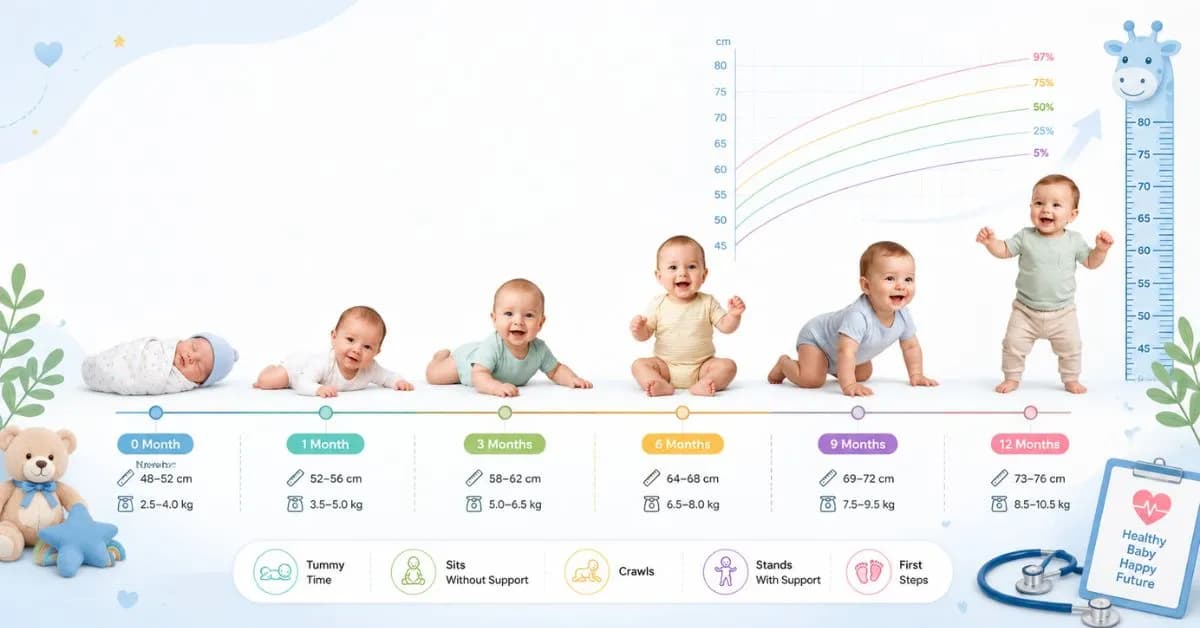
In the first year, a baby’s growth is rapid. Weight increases step by step and height rises in steady stages. Although each baby grows differently, there are common ranges that indicate what is usually expected.
The table below shows the typical weight and height ranges from birth to 12 months. These are general reference points for a baby’s growth and not fixed targets. Small differences are normal.
Age | Weight Range | Height Range |
Birth | 2.5 kg to 4.0 kg | 48 cm to 52 cm |
1 month | 3.2 kg to 4.5 kg | 50 cm to 55 cm |
3 months | 5.0 kg to 6.5 kg | 57 cm to 62 cm |
6 months | 6.5 kg to 8.5 kg | 63 cm to 68 cm |
9 months | 7.5 kg to 9.5 kg | 67 cm to 73 cm |
12 months | 8.0 kg to 10.5 kg | 71 cm to 78 cm |
Some babies show faster early growth, while others follow a slower and steadier path. Both can be normal as long as the baby’s growth follows a consistent pattern over time.
5 Common Signs of Healthy Growth in Babies
While all babies grow at their own pace, there are still common patterns that can help parents understand whether growth is progressing in a healthy direction. Looking at these patterns over time can make it easier to understand overall development during the first year.
Here are five common signs of healthy growth in babies.
Steady Weight Gain
One of the most common signs of healthy growth in babies is steady weight gain during the first year. Healthy weight gain during the first year usually reflects steady physical growth over time.
Regular Increase Over Time: A baby should continue gaining weight gradually as the months pass, even if some weeks show smaller changes than others.
Gradual Weight Changes Over Time: A baby should show gradual increases in weight over time rather than sudden large changes.
Growth Should Match the Baby’s Age: Weight gain should happen more quickly during the early months and become slower gradually as the baby grows older.
Steady weight gain over time often shows that a baby’s growth is moving in a healthy direction.
Gradual Increase in Height
In addition to gaining weight steadily, a baby should also continue growing in height during the first year. Height growth is usually easier to notice over longer periods rather than through daily changes.
Clothes May Start Feeling Smaller: A baby may outgrow clothes quickly during the first year as height continues increasing over time.
Height Should Increase Between Checkups: Regular doctor visits should usually show gradual increases in a baby’s height over the months.
Body Growth Should Look Balanced: A baby’s arms, legs, and overall body size should continue changing gradually as height increases.
If your little one continues growing taller over time, it usually reflects healthy physical growth during the first year.
Active and Alert Behavior
Whether it is reacting to sounds, watching movement, or staying active during awake time, behavior can reveal a lot about a baby’s growth during the first year. Babies who stay responsive and engaged often show healthy physical and mental development.
Responses to Sounds May Become More Noticeable: A baby may begin reacting more often to voices, sounds, and familiar faces during daily interactions.
Interest in Surroundings Should Grow: A baby should begin paying more attention to movement, objects, and people around them over time.
Body Movement Should Become More Active: A baby should show more stretching, kicking, rolling, and other body movements during the first year.
Active and alert behavior during awake time is often seen as a healthy sign of overall growth and development.
Regular Feeding Patterns
The way feeding habits develop over time can reveal a lot about a baby’s overall growth and nutritional progress during the first year. A baby’s eating habits often show how comfortably and consistently they take in nourishment during daily routines.
Eating Should Happen Regularly: A baby should eat consistently throughout the day and night during the first year.
Eating Patterns Should Stabilize: Eating habits should slowly become more structured over the first year.
Interest in Eating Should Continue: A baby should usually remain interested in eating and continue taking milk regularly over time.
Regular feeding patterns are often seen as a healthy sign of steady growth and development.
Sleep Patterns That Match Age
Sleep is closely connected with growth and development during infancy. Sleep patterns change gradually as babies grow older.
Sleep Should Follow Day and Night Cycles: Over time, sleep should start aligning more with night hours and be less spread throughout the day.
Sleep Should Become More Continuous: A baby should gradually shift from short, frequent sleep periods to longer, more stable sleep stretches.
Wake-Ups Should Gradually Reduce: Night waking is common early on, but it should slowly become less frequent as the baby grows.
Sleep patterns that match a baby’s age often reflect healthy overall development.
When Should a Baby’s Growth Be Monitored More Closely?
Let’s face it, not all changes in a baby’s growth follow a healthy pattern, and some can be a cause for concern. In some cases, growth may slow down or become uneven, which can signal that something needs closer observation. A baby’s growth pattern should normally show steady progress over time, and noticeable inconsistency in this pattern may need attention. Sudden changes in expected weight or height progression over a short period may sometimes indicate that growth is not following a typical path.
At the same time, long-term patterns are important to watch. Looking at weight, height, feeding, sleep, energy levels, and milestones together often gives a clearer picture than looking at one change alone. A baby may show slower weight gain for a short period but still remain active, feed well, and continue growing in height. In many cases, this may simply reflect a temporary stage rather than a serious concern.
Even though small day-to-day differences are common and may not mean much on their own, recurring patterns over a longer period can help determine if a baby’s growth is steady or if closer attention is needed. Reviewing consistent weight as well as height records against growth charts can make overall growth trends easier to see.
Parents should also remember that comparing one baby with another is not always helpful. Some babies naturally weigh more, grow taller faster or reach milestones earlier. Others may progress more slowly while still remaining healthy. The focus should stay on steady overall progress instead of short-term comparisons.
The table below shows common signs that may need attention and what they can mean for a baby’s growth.
Sign | What It May Mean |
No weight gain for several weeks | Babies usually gain weight steadily during the first year. A long pause in weight gain may suggest that feeding, nutrition, or overall health needs closer review. |
Sudden drop in growth pattern | A noticeable slowdown after steady progress may mean a baby’s growth pattern should be checked more closely over time. |
Ongoing poor feeding | Feeding less often or taking very small amounts regularly may affect the nutrition needed for healthy growth and daily energy. |
Low energy or unusual tiredness | Babies are often active and responsive during awake time. Long periods of low energy may point to a possible health or growth concern. |
Delay in key milestones over time | Some variation is normal, but delays across several milestones over a longer period may need further review. |
Poor increase in height over months | Height usually increases gradually during the first year. Very little change over several months may need closer observation. |
Less interest in surroundings | Babies often react to movement, sounds, and faces. Reduced interest over time may be worth monitoring along with other growth changes. |
These signs do not always mean a serious issue. They are signals to observe a baby’s growth more closely and consult a doctor if they continue.
Frequently Asked Questions
Do all babies follow the same growth pattern?
No. A baby’s growth can vary from child to child. Some grow fast early, while others grow later. Both patterns are normal.
How often should a baby’s growth be checked?
A baby’s growth should be checked during routine doctor visits. Along with this, parents should regularly track a baby’s growth at home using an app to maintain a simple record between visits.
What affects a baby’s growth the most?
Feeding, sleep, health, and birth weight all play a role in how a baby’s growth progresses.
Should parents worry if a baby is smaller than others?
Size alone is not important. The focus should be on regular growth in weight, height, and overall development over time, rather than comparing a baby with others.
Conclusion
A baby’s growth in the first year is fast and different for every child. Weight, height, feeding, sleep, and milestones together show the full picture when viewed over time.
By using simple tracking methods and clear growth charts, you can easily understand how a baby is developing and spot changes in growth over time.
Are you looking for a Baby Growth Tracker App with WHO Growth Charts that makes it simple to track a baby’s growth and daily changes in one place? The ParentZ app helps parents record weight, height, and milestones and track growth using charts in a clear and easy way.
More in this Category

How Sleep Tracking Can Reveal Changes in Your Baby’s Sleep Pattern
Discover how tracking your baby's sleep can help parents notice changes in naps, bedtime, wake-up times, night wake-ups, and overall sleep patterns over time.

How to Track Breastfeeding, Bottle Feeds, and More with a Baby Feeding Tracker App
Learn how a baby feeding tracker app can help parents easily record breastfeeding, bottle feeds, pumping, formula, and feeding history while keeping important feeding details organized in one place.

How to Choose Safe and Nutritious First Foods for Your Baby
Learn how to choose safe and nutritious first foods for your baby, with practical tips on food texture, key nutrients, choking hazards, added salt and sugar, and simple food preparation.

How a Baby Development Tracker App Makes Growth Monitoring Easier for Parents
A baby development tracker app makes it easier for parents to monitor their child's growth, record developmental milestones, organize important updates, and follow progress over time.

Why Modern Parents Need an All-in-One Child Health and Growth Tracker App with an AI Assistant
An all-in-one child health and growth tracker app helps modern parents manage health records, track growth and milestones, receive reminders, and get AI-powered parenting support in one place.

Best Baby Milestone Tracker App for Android and iPhone: Features Every Parent Should Look For
Discover the key features parents should look for in a baby milestone tracker app, from milestone and growth tracking to feeding, sleep, personalized insights, and secure data storage.